Showing posts with label dystopia. Show all posts

The Book of Air by Joe Treasure

Monday, 21 August 2017

Retreating from an airborne virus with a uniquely unsettling symptom, property developer Jason escapes London for his country estate, where he is forced to negotiate a new way of living with an assortment of fellow survivors.

Far in the future, an isolated community of descendants continue to farm this same estate. Among their most treasured possessions are a few books, including a copy of Jane Eyre, from which they have constructed their hierarchies, rituals and beliefs. When 15-year-old Agnes begins to record the events of her life, she has no idea what consequences will follow. Locked away for her transgressions, she escapes to the urban ruins and a kind of freedom, but must decide where her future lies.

These two stories interweave, illuminating each other in unexpected ways and offering long vistas of loss, regeneration and wonder.

The Book of Air is a story of survival, the shaping of memory and the enduring impulse to find meaning in a turbulent world.

The Glimpse by Claire Merle

Monday, 10 July 2017

In a near future, society is segregated according to whether people are genetically disposed to mental illness. 17-year-old Ana has been living the privileged life of a Pure due to an error in her DNA test. When the authorities find out, she faces banishment from her safe Community, a fate only thwarted by the fact that she has already been promised to Pure-boy Jasper Taurell.

Jasper is from a rich and influential family and despite Ana’s condition, wants to be with her. The authorities grant Ana a tentative reprieve. If she is joined to Jasper before her 18th birthday, she may stay in the Community until her illness manifests. But if Jasper changes his mind, she will be cast out among the Crazies. As Ana’s joining ceremony and her birthday loom closer, she dares to hope she will be saved from the horror of the City and live a ‘normal’ life. But then Jasper disappears.

Led to believe Jasper has been taken by a strange sect the authorities will not interfere with, Ana sneaks out of her well-guarded Community to find him herself. Her search takes her through the underbelly of society, and as she delves deeper into the mystery of Jasper’s abduction she uncovers some devastating truths that destroy everything she has grown up to believe.

Why Legend Wasn't Quite My Champion

Friday, 5 May 2017

Marie Lu knows how to write action scenes that hold your attention, I'll say that much. But just how good is her Legend trilogy?

The Catalyst by Helena Coggan

Monday, 13 March 2017

The Catalyst
Helena Coggan
Genre(s): Dystopia, Fantasy, Young Adult
Published: February 19th 2015
Pages: 448
Rating: 1 star

Rose Elmsworth has a secret. For eighteen years, the world has been divided into the magically Gifted and the non-magical Ashkind, but Rose's identity is far more dangerous. At fifteen, she has earned herself a place alongside her father in the Department, a brutal law-enforcement organisation run by the Gifted to control the Ashkind. But now an old enemy is threatening to start a catastrophic war, and Rose faces a challenging test of her loyalties. How much does she really know about her father's past? How far is the Department willing to go to keep the peace? And, if the time comes, will Rose choose to protect her secret, or the people she loves?

The Catalyst
has a complex world and magic system, there’s no denying that. It took me a while to get my head around the Gifted, Leeched, and Ashkind and where they stood in society. And that was before I moved on to trying to understand the War and the Angels and the Department…

It’s extremely impressive that Coggan was published at such a young age – don’t get me wrong – but I feel as if her age is also extremely apparent throughout her novel. I found this mostly in the writing style which needed fine tuning. Some sentences brought me straight back to my Year Six and Seven writing – not something an author should be aiming for. Some sentences were stilted and some were so long I had to re-read them a few times. Others were missing commas (or rather, I thought they were; I’m a habitual comma splicer so maybe don’t listen to me) and some words just seemed… out of place. I’m all for expanding your vocabulary, but some of the ‘big’ words just felt off next to everything else.

A lot of the characterisations felt one-sided and childish; the main character was the typical snarky, less than perfect teen who is much wiser than all the adults, and the adults just didn’t feel like adults. Rose and David felt more like hero and sidekick than father and daughter. And David wasn’t the hero. The younger characters, especially Tabitha, all felt far too clever and knowledgeable in comparison to the older ones who came across as very childish.

The plot jumped from place to place and nothing ever really seemed to be fully explained, and even when things were explained I still didn’t fully understand anything. The prologue managed to pull you in, but once you were part of the story you were left thinking ‘now what?’ It was as if Coggan thought she’d provided all the necessary information, but then realised it wasn’t enough and scrambled to explain things more fully. All in all, it felt all over the place. Explain as you go, don’t delegate every other chapter to world building.

I wanted to like this; it seemed mysterious and set itself up to be an interesting young adult fantasy. Its biggest downfall was that it was so bloody boring. This isn’t a long book but my god did it feel like one. Each page was a chore to read and I had to force myself to push through in order to complete it. Curse my inability to leave a book unfinished.

Don’t subject yourself to the same torture – give this one a miss.

Recommendations: Sci-Fi and Dystopia

Friday, 24 February 2017

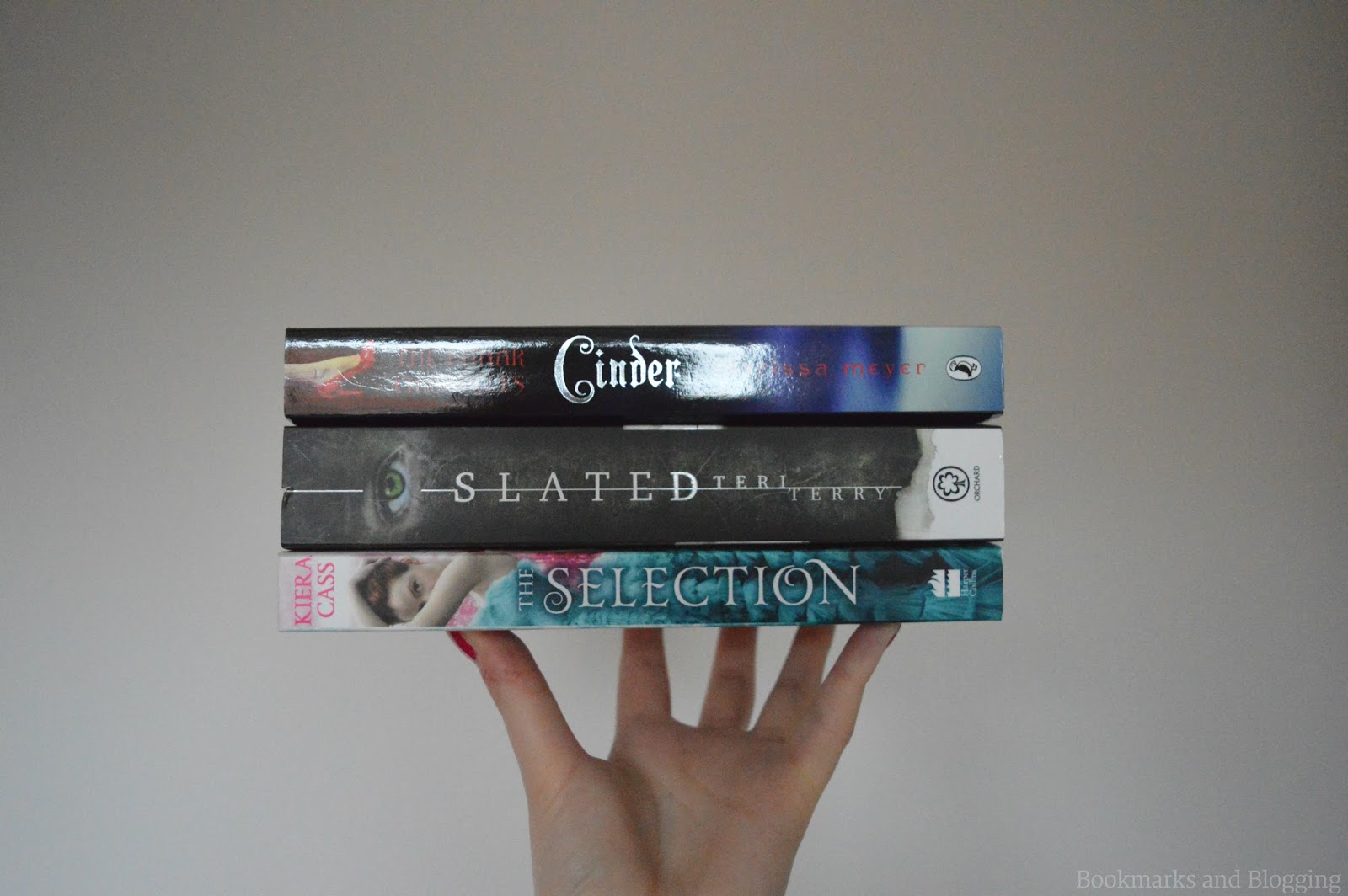
Cinder by Marissa Meyer
If you want sci-fi with androids, cyborg, and aliens but still want a fun young adult story then The Lunar Chronicles is the way to go. Cinder introduces all the spacey and futuristic elements but it also lays the foundations for the bigger picture. And it's a quick, fun read - what more could you want?

Slated by Teri Terry
A dystopian with some scientific (and political) elements, Slated is a bit darker but still an incredibly gripping and compelling read. Full of mystery, you can't help but read on as you try and piece everything together alongside the main character, Kyla. 

The Selection by Kiera Cass
And if you want something more romantic but still crave the action that comes with the dystopian genre, The Selection series is the one for you. Packed with princess dresses and drama the first book is less focused on the dystopian world, but it's so damn cute it doesn't matter.

TBR Feature #40

Wednesday, 8 February 2017

TBR Feature is the chance for me to, every Wednesday, pick one of my unread books and discuss it: why I picked it up, when I'll get round to reading it, if I'm still interested in it at all etc.

Legend by Marie Lu

Poisoned Iris by Cindy Mezni

Monday, 23 January 2017

Poisoned Iris
Cindy Mezni
Genre(s): Dystopia, Science Fiction, Young Adult
Published: December 26th 2016
Pages: 463
Rating: 3 stars

Athens was once the cradle of civilization. Now it's slowly but surely becoming the tomb of humanity.

The Red Plague, a violent virus which had run rampant decades ago, left its imprint on the planet and the flesh of men. All that remains of the modern world is an endless wasteland of ruins—Erebos—and two cities—Elysion, the obscure island of the Non-Infecteds about which no one knows a thing, and, Tartaros, the crumbling town of the Infecteds where despair, hatred, violence and poverty are the operative words.

And at the heart of this universe lives Irisya, a sixteen-year-old Non-Infected girl, staying recluse in her home to be safe and relying on her brother, Memphis, for everything.

But then, one day, he disappears without a trace.

Irisya has no choice. To save him, to survive, she will have to brave all the dangers of the outside world.

A copy of this book was provided by the author in exchange for an honest review. This in no way influenced by thoughts.

What would you do for the person you're closest to? Irisya, the main character in Poisoned Iris, is willing to sacrifice herself and her safety in order to find her brother, heading out into the world of the Infecteds with next to no knowledge on how to defend herself.

We join her on her adventure almost immediately - there are very few chapters spent explaining the new world before Irisya leaves on the hunt for Memphis. I really appreciated this fast pace, as it meant nothing dragged and we could get right into things, while still having the essential information about Tartaros. (I also really liked how this was set in what would have been Greece before the Red Plague, as I'm a sucker for the mythology.)

While I liked Irisya as a character, I didn't really care for Memphis. The way he treated her at the start of the book put me off him, and I never really came around. His sister, however, interested me from the get go, as she starts off as quite a timid, unsure person but soon grows stronger and learns a lot as she journey's through Tartaros. Gem and Cillian are also intriguing from the moment we meet them - they're fierce and loyal to each other but have distinctly contrasting attitudes when it comes to helping Irisya.

The writing was nice - not too slow, not confusing or overly complex - but I did feel like it was a little... off. Some word choices, and the phrasing of certain things were odd and could have benefitted from some refinement and heavy editing to get rid of mistakes. Gem, especially, made me question the writing style, as she doesn't speak in complete sentences. However, this is more of a stylistic choice and we learn why as the story progresses. Overall, though, it didn't hinder my enjoyment of the story for what it was.

The plot was a little on the meandering side as the story progressed, jumping from place to place and taking time in providing the answers you need. It wasn't necessarily bad, but I would have preferred it to be a bit faster as it did take me some time to get through it and it became less enjoyable to read. There were certain parts that stood out to me - like Mount Thanatos - but there were others that I didn't care for at all.

My biggest problem, however, was Cillian. I just... didn't like him. He constantly flip flopped between angsty and brooding to sweet and hurt, and I didn't like his moments of vulnerability as they felt fake and just down right odd coming from him. I also didn't like how he was used to withhold information; telling Irisya that now wasn't the right time for her to know things, meaning we were kept in 'suspense' for far too long. It did more to irritate me than compel me to keep reading.

Things do get back on track towards the end, but by that point it's a little too late. Which is a shame as I love the ideas behind this and felt that it had so much potential. That being said, it's not a bad book by any means and if you're intrigued by it, definitely give it a go.

Cindy Mezni and her work can be found at...
Website
Facebook
Twitter
Goodreads
Wattpad
Amazon UK
Amazon US

TBR Feature #36

Wednesday, 11 January 2017

TBR Feature is the chance for me to, every Wednesday, pick one of my unread books and discuss it: why I picked it up, when I'll get round to reading it, if I'm still interested in it at all etc.

The Bone Season by Samantha Shannon

TBR Feature #34

Wednesday, 28 December 2016

TBR Feature is the chance for me to, every Wednesday, pick one of my unread books and discuss it: why I picked it up, when I'll get round to reading it, if I'm still interested in it at all etc.

1984 by George Orwell

TBR Feature #33

Wednesday, 21 December 2016

TBR Feature is the chance for me to, every Wednesday, pick one of my unread books and discuss it: why I picked it up, when I'll get round to reading it, if I'm still interested in it at all etc.

The Glimpse by Claire Merle

TBR Feature #27

Wednesday, 9 November 2016

TBR Feature is the chance for me to, every Wednesday, pick one of my unread books and discuss it: why I picked it up, when I'll get round to reading it, if I'm still interested in it at all etc.

The Young World by Chris Weitz

TBR Feature #8

Wednesday, 15 June 2016

TBR Feature is the chance for me to, every Wednesday, pick one of my unread books and discuss it: why I picked it up, when I'll get round to reading it, if I'm still interested in it at all etc.

Split Second by Sophie McKenzie

Book Review: Slated by Teri Terry

Friday, 5 September 2014

Slated
Teri Terry
Genre(s): Dystopia, Science Fiction, Young Adult
Published: May 3rd 2012
Pages: 448
Rating: 5 stars

Kyla’s memory has been erased,

her personality wiped blank,
her memories lost for ever.

She’s been Slated.


The government claims she was a terrorist and that they are giving her a second chance - as long as she plays by their rules. But echoes of the past whisper in Kyla’s mind. Someone is lying to her, and nothing is as it seems. Who can she trust in her search for the truth?

I'd been putting off reading Slated for almost a year before I decided to pick it up. Why? I don't know, because I really enjoyed it.

I knew straight away from the prologue that this was going to be a book that kept me wondering, and maybe even a little confused at times. I instantly started questioning things and wanting to find out more. Why was Kyla running? Who spoke to her?

My questioning continued throughout the story, where I found new thoughts and ideas were not explained as they were brought up, but instead touched upon again later in the story. On one hand I like this, as it added to the mystery for me as a reader, and I found it believable as Kyla, as a Slated and the narrator, wouldn't know or understand everything straight away and therefore be able to explain things. On the other hand, however, it annoyed me, as I like things to be laid out clearly at the start of the story. It took a while for things like the Levo to be explained and this did frustrate me, but again, it's believable, as Kyla would already know all about them an wouldn't do that annoying 'this is my Levo. It does this, this, and this' explanation that is sadly all too common in first person fiction.

I was intrigued by the world building, as well. More so in a good way than a 'huh?' way. I really enjoyed how it read as if it was set in the present, even though it was set a couple of decades in the future. It wasn't glaringly obvious that it was a futuristic/sci-fi/dystopian story from the setting, which pleased me as I'm iffy with those genres, and the characters seemed 'normal' enough to be part of our present day world.

The characters also kept me guessing. I liked how they all had different personalities and characteristics, no one felt like they were just a copy of someone else, and I kept trying to figure out their motives and reasoning for things. I really enjoyed the development as well; everyone started off as quite one dimensional but I found that that soon changed, whether that was because of Kyla's own development and narration, I don't know. 

While I did find the writing to be quite simplistic, as well as choppy and jarring at times, I did - for the most part - like it. I felt that it represented Kyla's thoughts well, as she would be very confused by things and no doubt think in a choppy and jarring way.

Despite me minor complaints, I did really, really enjoy Slated. It's probably the best dystopian I've read. I can't wait to complete the trilogy.

Book Review: Extras by Scott Westerfeld

Friday, 23 May 2014

Extras
Scott Westerfeld
Genre(s): Dystopia, Science Fiction, Young Adult
Published: September 1st 2012
Pages: 417
Rating: 2 stars

These days it's all about the fame.

As if life isn't hard enough when you're fifteen, Aya Fuse's face rank of 451,369 is so low, she's a total nobody. An Extra. But when she meets a clique of girls who pull crazy, dangerous tricks in secret, Aya sees a way to get her popularity rating to soar...


Aya is sure she's destined for a life in the spotlight, and if she can just kick the story to show everyone how intensely cool the Sly Girls are, then the spotlight will be on her. 


But is Aya really prepared to be propelled out of Extra-land and into a world of instant fame, celebrity... and extreme danger?


Before I picked this up, I thought it was a companion book to the Uglies trilogy. With that in mind, I was interested to read it and see what happened because the other books were okay - nothing amazing yet nothing to really regret reading.

When I learnt that this is actually the fourth book in the series that interest disappeared. From reading the blurb I knew that this was about a different set of characters in the 'new world' Tally and her friends were responsible for, and that the issues about to be faced weren't to do with the uglies/pretties/specials programme.

Knowing that, I ask: why? Why is this part of the series and not a companion novel?

From the very first chapter, Aya annoyed me. More so than Tally did in the first three books. The way she talks using words like 'scary-making' and 'wrist-hurting' made her sound juvenile and immature, not fun and quirky like I assume Westerfeld intended. She also came across as quite shallow and whiny, and the way she obsessed over her face rank got old very quickly.

I also felt that Westerfeld had undone all the work the original trilogy had done about showing that looks aren't everything, as people were still having 'surge' and caring about looking 'good'. (However, I felt this at the end of Specials, as well, when it took that weird environmentalist kick or whatever it was at the end. It felt very out of place and left me very dissatisfied.) Yes, the focus is now on fame and reputation, but looks certainly play a large part in that (notice how many of the higher ranking, 'non-extra' people are described as looking nice or having surge) and I thought that - after Specials - people weren't supposed to care any more?

The way technology is explained is well... it's not, really. I had a lot of trouble getting my head around the things like smart matter and the mag-lev trains. Perhaps this was partly due to the amount of time I left between reading Specials and Extras which meant I was out of touch with the world, but I feel it was down to Westerfeld failing to make things clear and understandable, like things in a dystopian/science fiction world should be.

That being said, I did enjoy the pacing of this. While I was left wondering what on Earth this story had to do with the original trilogy, I didn't find it especially boring or dread picking it up to read the next chapter. In fact, I found Westerfeld's writing to be entertaining, if not especially complex or mind-blowing.

Overall, I feel that this book was very extra and should have remained as a companion novel or just never have been written. I wouldn't recommend it unless you absolutely fell in love with the first three books.

Book Review: Cinder by Marissa Meyer

Saturday, 5 October 2013

Cinder (Lunar Chronicles, #1)Cinder
Marissa Meyer
Genre(s): young adult, science fiction, dystopia
Published: January 5th 2012
Pages: 387
Rating: 3 stars

Humans and androids crowd the raucous streets of New Beijing. A deadly plague ravages the population. From space, a ruthless lunar people watch, waiting to make their move. No one knows that Earth’s fate hinges on one girl. . . . 

Cinder, a gifted mechanic, is a cyborg. She’s a second-class citizen with a mysterious past, reviled by her stepmother and blamed for her stepsister’s illness. But when her life becomes intertwined with the handsome Prince Kai’s, she suddenly finds herself at the center of an intergalactic struggle, and a forbidden attraction. Caught between duty and freedom, loyalty and betrayal, she must uncover secrets about her past in order to protect her world’s future.

Cinder is not your average fairy-tale retelling. It's set in a post-WWIV world with cyborgs, aliens and advanced technology, with a distinct lack of singing and helpful woodland creatures.

While that all sounds excellent, I can't help but feel a little unfulfilled. The fairy-tale, I found, was pushed aside almost completely, with only a few hints towards it throughout the book. Shelving that plot did open the story up for Marissa Meyer's new world, though, which ended up being a lot more interesting.

The setting for Cinder is certainly unique and intriguing, but I found it to be a little under-explained for how complex everything is. You're thrown in at the deep end, left floundering about in a wash of terminology that is never fully expanded on, as well as a whole new set up to the planet and how its countries are ruled. With a little more work, New Beijing and the entire Eastern Commonwealth could become a world as well known and loved as The Hunger Games' Panem or Harry Potter's Hogwarts.

Not to worry though, as Cinder herself seems to struggle with keeping up with it all, as the life-saving cyborg surgery she underwent five years ago has wiped her memories. At first, after I learnt that, I was hesitant about her. Having no memories is a perfect set-up for a weak character who falls prey to insta-love and walks right into the bad guy's plans. Fortunately, with Cinder, this wasn't the case. She is independent and strong, and doesn't really have a problem with standing up for herself.

Cinder was a very quick read due to the writing style, which wasn't especially complex, and - while I don't always enjoy science-fiction - I am finding myself wanting to read the sequel, and all the other books in the series.
design by amanda inez